
Ladytron
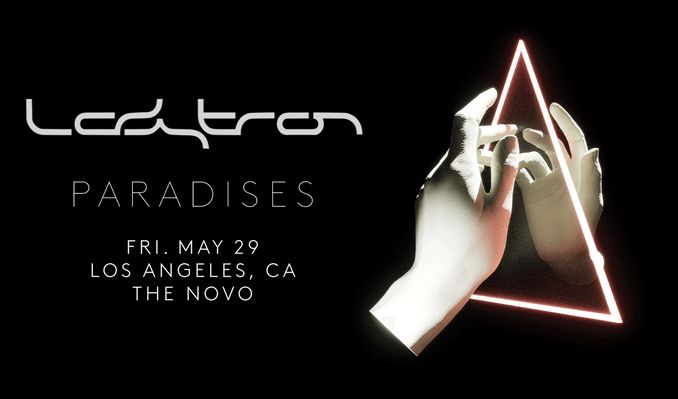
Originating in Liverpool, England, Ladytron have earned decades of acclaim since their
foundation by relentlessly pushing boundaries, carving out new sonic and conceptual space,
and refusing to abide by formula or trend.
In the beginning, they revelled in cute situationist mischief: opaque messages, matching
uniforms, and live shows in unconventional spaces, such as a disused bank in East Berlin or a
bowling alley in a Paris Metro station. In addition, the group, already international in its makeup,
placed more emphasis on countries and cities other than its own. Thus, the group’s worldwide
recognition quickly grew — playing to audiences in places where few artists went at that time,
such as China and Colombia.
Along the way, they twice took their primitive electronics to more familiar territory, two visits to
California’s Coachella Festival, on relentless tours across Europe, Asia, North and South
America, and were invited to perform with artists such as Bjork, Nine Inch Nails, and for Brian
Eno’s curated festival at the Sydney Opera House. Eno remarked in an interview, “Ladytron
are, for me, the best of British pop music. They’re the kind of band that really only appears in
Britain, with this funny mixture of eccentric art-school dicking around and dressing up, with a full
awareness of what’s happening everywhere musically, which is kind of knitted together and
woven into something quite new.”
Now made up of trio Helen Marnie, Daniel Hunt, and Mira Aroyo, Ladytron’s origins were in
lo-fi electronic pop, the original dreampop/shoegaze movement, catalysed by Liverpool’s DIY
post-punk counterculture, and under the subliminal influence of the pervasive dance music in
the city at that time. Made with then cheap and unfashionable electronic instruments which now
fetch tens of thousands of dollars, their raw and minimal debut, 604 in 2001, was made in that
improvised context. Its successor, 2002’s more refined and diverse Light & Magic, which was
recorded in Manchester and Los Angeles, had Ladytron grouped with the new electro wave and
placed reluctantly at the forefront of the so-called Electroclash movement. Amongst Rolling
Stone’s albums of the year, the dance music press also took Ladytron to its heart, with DJ
deeming Light & Magic “Dazzling. This album blows most contemporary home-spun dance-
influenced pop music out of the water.” and Mixmag proclaiming that “You’ll believe that
Ladytron are the only band you ever really liked”.
2005’s Witching Hour saw them break out and win over a whole new audience. Pitchfork
wrote: “Every quantum leap record has a quantum leap single, and in this case, it’s ‘Destroy
Everything You Touch.’ With a charging chorus and shivery production that sounds as equally
indebted to shoegaze as it does synthpop, this is probably the most confident and menacing
thing they’ve ever done.” 2008’s harder, darker, Parisian-made Velocifero saw them grow
further with the iconic singles “Ghosts,” “Runaway,” and “Tomorrow.”. Key to Ladytron’s
individuality and creative progress was never responding to any contemporary movement,
scene, or sound.Over these early albums, with their label and organisational base in Los Angeles, and their
music a staple on the taste-making KCRW radio station, their name
became a reference point, and their sound caught the eyes and ears of some of the biggest
writers and producers in the business. Ladytron’s influence, not just on a new wave of
underground electronic pop acts that would emerge over the coming decade, but on the
mainstream, was further evidenced when superstar fan Christina Aguilera invited the group to
write and produce for her.
After a retrospective collection, a fifth studio album, 2011’s meditative Gravity the Seducer,
and another world tour culminating in a euphoric sell-out at the Los Angeles Wiltern Theatre,
the band went silent. Over time, this mystery perplexed the group’s still-growing audience. With
no shows and barely any social media activity, rumours spread about what had happened to
Ladytron. In the following years, as the synth-dominated sound became a blueprint for modern
pop music production, and the analogue machines with which it was originally built were revived
and turned into a billion-dollar industry, there was still no word from Ladytron, as the scattered
group members embarked on movie scores, collaborations, and solo projects.
In early 2018, radio silence was finally broken with a startling new song from nowhere, “The
Animals”, and an announcement of their new album, their eponymous sixth. It was released to
critical acclaim, with Q Magazine calling it “Their finest record since 2002’s Light & Magic,” and
that “Ladytron achieve near perfection here.” Mojo insisted that in “Dark times, Ladytron
soundtrack them beautifully…” GQ described it as “Formidable machine music, full of urgency
and menace,” while NPR posited that “Ladytron seems enraptured at the idea of change, and of
new beginnings in the face of a possible fiery end…“ BlackBook called it simply “Ladytron at
their absolutely most sublime.”
Fittingly, the dislocated follow-up, Time’s Arrow, arrived just as another moment from
Ladytron’s past returned, as the tides of the digital ocean moved in mysterious ways. Unknown
to the group, “Seventeen”, the main single from 2002’s Light & Magic, had gone viral on TikTok,
and a new disaffected generation had been introduced to Ladytron’s music, with hundreds of
thousands of clips created, many of them with millions of views each. A twenty-year-old song by
a group whose very existence predated social media itself suddenly appeared as a top ten hit
around the world. As that strange rebirth shows, great work creates its own space. It never dies.
In 2025, Ladytron embarks on another chapter with the release of two singles this Fall, the
high priestess disco of “I Believe in You” and the techno-noir track “I See Red” with an album on
the way.
LADYTRON IN THE PRESS…
“Ladytron sound timeless.”
- Brooklyn Vegan
"The sheer beauty of every detail is impressive"
- DIY"Music capable of radiating a beatific warmth despite the inescapable darkness"
-The Line of Best Fit
"Burnished synth-pop meets the hyperreality of travel"
- Mojo
"...proves how intoxicating Ladytron’s enduring brand of atmospheric synth pop can be”
-Pitchfork
"...a transcendent space to lose yourself within.”
-Skinny
"Stylishly updating their signature sound world for a new decade"
- UNCUT
"They are iconic and influential in equal measures.”
-Under the Radar
